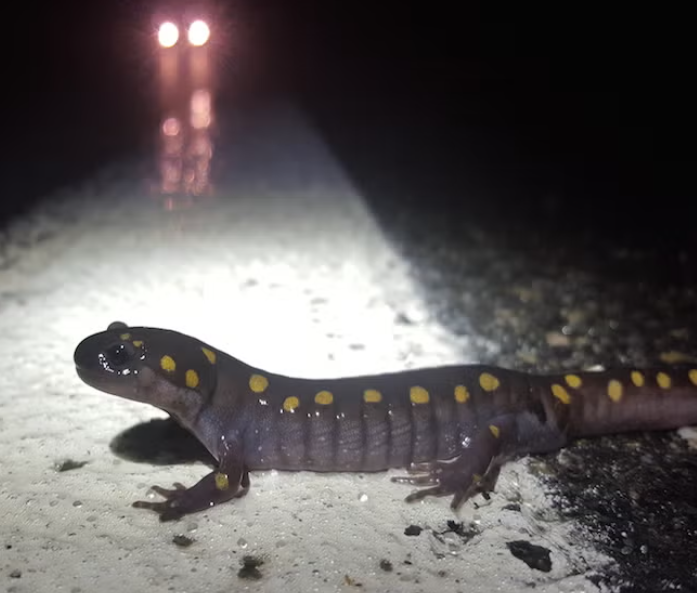
Collateral damage is another chapter from Braiding Sweetgrass by Robyn Wall Kimmerer. The chapter uses incredibly descriptive, immersive language to describe Robyn’s experience helping salamanders cross a road near her home as they migrate back to their birthplace to spawn the next generation. This chapter also coincides with the night that the USA began the bombing of Baghdad in 2003. Kimmerer makes the connection that the lizards that are killed are like the men who will die in the war, collateral damage. Both species will suffer from unintended consequences perpetuated by colonial powers seeking oil, the men in the desert will die for its acquisition, and the lizards will die because it fuels the vehicles that drive on the road in Kimmerer’s small town. “Collateral damage: shielding words to keep us from naming the consequences of a missile gone astray. The words ask us to turn our faces away, as if man-made destruction were an inescapable fact of nature.” (Kimmerer, 2016).
This chapter in the book I read three times. The language in it evokes feelings of sadness and hope. One is often not far behind the other. I began to examine what collateral damage could mean in my life and within our education system. Immediately, I thought of the Canadian government’s treatment of Indigenous communities and residential schools.
The thousands of people and communities who are suffering the ripple effects of decisions made in the not-too-distant past and who are still displaced by pipeline and dam projects, collateral damage.
I am reminded of cancer patients who lose parts of themselves and are told they will be sick from chemo for months and lose their hair and muscle mass, collateral damage.
I am reminded of the mine I used to work at, the spills and acid rock that would be stripped from the earth and left in piles to leach back into the soil and waterways, collateral damage.
I wonder what the unintended consequences of the curriculum I teach will be. Government-mandated curriculum affected Indigenous communities so deeply during the era of residential schools. Now the solution seems to be more government-mandated curriculum. In the field of medicine, we look back in horror at the practice of bloodletting and working in unsterile environments. If doctors in modern medicine used these practices, it would seem almost barbaric. However, in the future, will doctors, nurses, and scholars look back at chemotherapy in the same light? destroying a patient’s autoimmune function to destroy the cancer in the process? I often wonder if reconciliation could be seen in the same light? Surely, although each of us is doing our best, there will be unintended consequences of our actions. However, from sadness, there is always hope. In the chapter, Kimmerer sums it up best while describing saving the salamanders. “Carrying salamanders to safety also helps us to remember the covenant of reciprocity, the mutual responsibility that we have for each other. As the perpetrators of the war zone on this road, are we not bound to heal the wounds that we inflict?” (Kimmerer, 2016).
This chapter connects to the curriculum through social awareness and responsibility. Although one’s actions may have unintended consequences, we are all bound to heal the wounds we have inflicted on one another. Reflecting on the “why” behind the curriculum and its ties to reconciliation is at the core of becoming a competent educator who can teach our students. How we choose to get to a destination matters; all actions have consequences; and reciprocity and kindness create an environment where healing can happen. Engaging with these ideas while I develop curriculum for my class will hopefully help me reduce collateral damage in my own way and help students do the same. I wanted to close with one last quote from the chapter, as Robyn Wall Kimmerer says it best.
“We, the collateral, are your wealth, your teachers, your security, your family. Your strange hunger for ease should not mean a death sentence for the rest of Creation.” (Kimmerer, 2016)
Kimmerer, Robin Wall. Braiding Sweetgrass: Indigenous Wisdom, Scientific Knowledge and the Teachings of Plants (p. 359). Milkweed Editions. Kindle Edition.