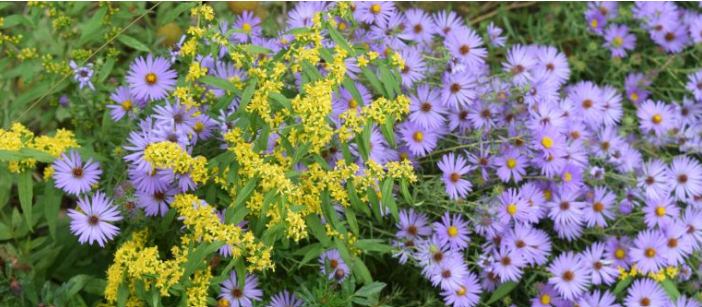
Asters and Goldenrod was the second chapter from Braiding Sweetgrass that we were asked to read for class, and it discusses Robyn’s entry into college. Robyn wanted to discover the relationship between the two flowers, asters and goldenrod. If the book is a heart, this chapter is a steady pulse beating within it. Asters and goldenrod highlight the juxtaposition of Robyn seeking “scientific” answers to relationships she has been observing her entire life. This theme is woven throughout the book as she finds out more and more that the world of science can be exclusive and does not always value traditional knowledge. A quote from the chapter highlights this relationship: “Yes, I have learned all the names of all the bushes, but I have yet to learn their songs” (Kimmerer, 2013).
This chapter highlights one of the most important parts of the science curriculum, inquiry. Robyn chose to attend university for several reasons, but one was that she was seeking answers to questions no one was asking. Building relationships with students so they can seek answers to their questions is one of the most important parts of being an educator. This revelation I have had is also supported by the BC curriculum through the Curriculum Competency “Demonstrate a sustained curiosity about a scientific topic or problem of personal interest” (BC Curriculum, grade 6). In fact, this idea of student-driven curiosity, personal interest, and inquiry is so important that it appears in almost every grade level of the curriculum.
This reflection has been included as a reminder to myself that it doesn’t always matter why a student is asking a question, nor whether I think it’s relevant. The important part is that they are curious. My job is to cultivate that curiosity and provide students with the tools to find their own answers. While it’s important to follow the explicit parts of the curriculum. It is equally important to attend to the implicit parts of the curriculum and to encourage students to create their own authentic learning opportunities through inquiry. Science exists because of curiosity; therefore, curiosity needs to be encouraged as much as theory.
Kimmerer, Robin Wall. Braiding Sweetgrass: Indigenous Wisdom, Scientific Knowledge and the Teachings of Plants. Milkweed Editions. Kindle Edition.